Showing posts with label Reading List. Show all posts

Friday, December 13, 2013

The Vogue Factor by Kirstie Clements


As an avid magazine reader, since my early Total Girl days, the process of print publications and the curatorship of articles, photographs, shoots, ideas and editorials have been high on my list of interests. Reading Clements' recount of her early fashion days living in Kings Cross and experimenting with second-hand finds, was humbling and incredibly relatable for a fellow twenty-something, Sydney girl. The journey is often said to be the destination, and it was fascinating to read of how Clements' early trips onto shoots with editors eventuated into full-blown international affairs, including Elizabeth Arden and Chanel escapades. It was insightful to learn the gravitas that shifts in management and publication owners have on the staff and the production of magazines - these business details were fascinating at times, however later on were a bit tedious to relate to for an outsider. Clements' focus on the office and the changing staff dynamic was understandable and, in a way, showed that the fashion industry is not just inspiration, innovation and beauty, but also a workplace - and that includes the not-so-glamorous parts. Reading the backstory of magazine issues that I had previously only seen for face value was delectable. I find the process of a shoot - from idea, to execution, to publication - incredibly inspiring, and there were moments in this book (especially the recount of shooting Mary, Princess of Denmark) that I absolutely ate up. That said, I didn't find the chapters dedicated to parties and events to be particularly captivating - perhaps this is a bit of a cynical view in a time where the documentation and sharing of events is already such a visually ubiquitous force. Intermingled between recounts of falling in love in Paris, changing jobs between Vogue and Harper's Bazaar, and trying to pin down Nicole Kidman, Clements touches on issues of skinny models, building the Vogue Australia brand, and its relevance in the global fashion scene. It is these moments, when Clement's speaks of her experiences as an Australian fashion editor, that I find most unique about this book. By the end, the recounts of events and shoots drag on a little - as if they were picked from a never-ending list of moments that could be made into chapters. This, however, does reinforce the overall tone a gratitude that Clements has in many of her recounts - her constant praise of fellow fashion-eers is humbling, however (as one review I read put it) can make the composition in sum seem like an elongated awards-acceptance speech. Overall The Vogue Factor, which perhaps could have been more aptly titled The Vogue I Knew or My Life In Vogue (as was the title of Clements' 2009 article pictured above), was quite an enjoyable insight into the world of publishing, the challenges of Australia's fashion identity, and the life of a Vogue veteran. 


Saturday, July 27, 2013

The Da Vinci Code by Dan Brown


After months of studying, art history essays, and reading for knowledge and education, I really just wanted a book to entertain me. I missed reading without a highlighter in my hand, without having to make footnotes. So, when I asked a friend for a recommendation of something I could just get addicted to, she recommended the Da Vinci Code, and oh man was it a page turner! I loved the feeling of devouring the pages with cliffhangers every second chapter, and I thought that the interwoven plots were clever and kept the reader on their toes. I admit that at first I was a little twitchy by the non-referenced discussion of art and historical events, and I didn't find the writing the most subtle or creative. But it was incredibly entertaining and certainly quenched my reading thirst, and for that I highly recommend it. 

Saturday, November 17, 2012

Reading Rookie


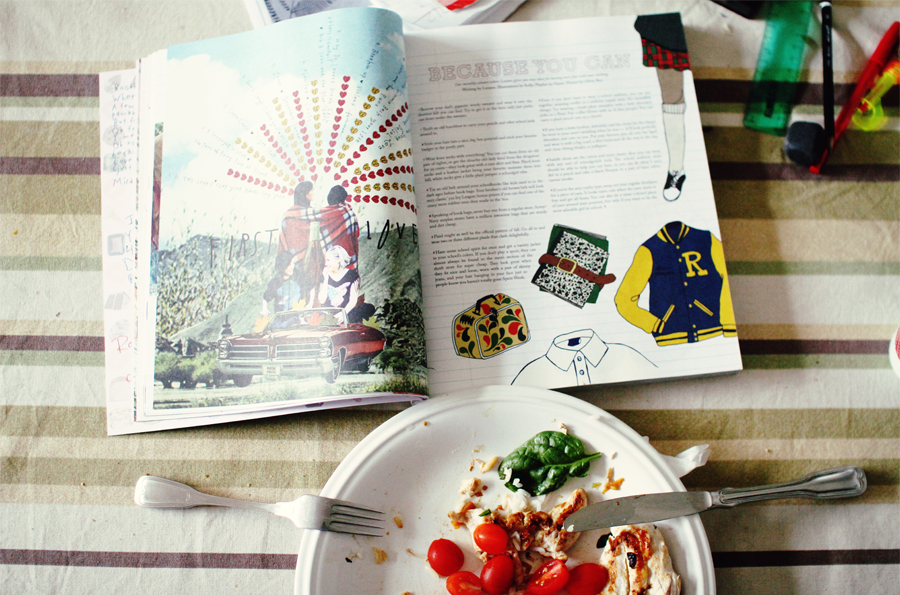
Eating dinner and reading Rookie Yearbook One - an omnibus of all things teen, with universal appeal and courageous charm. Wish there had been a resource like this when I was a teen, that immortalised less of this and encouraged more of this.

Saturday, September 1, 2012

The Clocks by Agatha Christie


In contrast to highly dramatic and explosive detective/crime stories which cater to a rather desensitised audience, Agatha Christie's series of Hercule Poirot is refreshingly witty, perplexing and subtle. A murder is of course to be expected in this novel, however the context of the crime scene (in the house of a blind, retired school teacher, at which four clocks set to 4:13 are left), the body (the identity of which is unknown), and the characters (all of which seem rather unrelated) are anything but predictable. The attention to detail with shifts between narratorial perspectives and carefully articulated dialogues make for a captivating text, however require the full attention of the reader (who in the back of the minds secretly wishes to solve the case before Poirot - however, inevitably knows that this is a rather futile goal). My only complaint would be the large absence of the Belgium detective himself, whose senses of quirk and wisdom seem paralleled perhaps only by that of Professor Dumbledore. All in all, a very enjoyable read however with such an intriguing character as Poirot, why not include him a little more? 

Tuesday, April 3, 2012

The Hunger Games by Suzanne Collins

From left to right: gold fabric and candles for "Katniss: the girl on fire;" foliage for the arena; a mockingjay bird (as close to a prop I could find); Nightlock berries; a pair of tweezers for Octavia; nail file for Venia; birds to sing in the forest; bread (a favourite part of the book for me is when Katniss thanks the people of District 11)

***

There are many ways to read a book: in a hammock at a leisurely pace; with a furiously scanning eye; with a cup of coffee; with the rattle of the train… For me, however, it is the all attention-consuming fervent all nighter practice that I find myself subscribing to of late. And so this was the case with my most recent read, Collins’ dystopian novel, The Hunger Games. I finished the book in less than 24 hours, devouring the ups and downs in a somewhat appropriately ravenous fashion. I found myself reading at 3am with absolutely no desire to move either physically or mentally until I read the last sentence on the last page – read the very last full stop of the story.

I found Collins’ construction and detail of a world so uncannily similar yet distant of our own completely captivating and at the same time disconcerting. Her emphasis on the tense dichotomy between the controlling and the controlled in particular, for me, illustrated and implied a complex system of motivations which, in a sense, has breathed light onto the way I perceive the complexities of the real world. I appreciate her use of first person, which I found highly effective in illustrating the human psyche when it is put under the most extremes of pressure, and thus posing intriguing questions of morality, virtue and that ever defining trope of choice.

The focus on the construction of image was also a key matter of interest for me - from the emphasis on the way 'tributes' are dressed; to the way people in the Capitol go as far as to hyperbolically dye and tattoo their skin for fashion; how carefully personalities are considered for an audience; even the topic of plastic surgery. I found it interesting how the spectrums of necessity, excessiveness, and immorality were called to question in regards to such contructions of image. I thought that Collins proposed a very thorough and poignant look at aspect of an image-based culture which on a parallel run deep in the veins of ours today.

I was impressed with the depth and variety of the characters; none of whom I loved or hated but rather was drawn to admire, question, enquire about or empathise with: Cinna, I wish you would elaborate more on your bittersweet statements… Oh Peeta, you are much too caring for your own good… how much tesserae would I sign up for on behalf of my siblings? In regards to being classified as a young adults novel, I think the book offers more than mere entertainment value and raises questions relevant to the human condition, accessible to a plethora of readers no matter what their age.

Sunday, February 26, 2012

The Borrowers by Mary Norton


I was drawn to read Norton's classic children's book by the release of the film interpretation 'Arietty' (Studio Ghibli, 2010) and the fear that I would not get the most I could from the film without knowing its precursor (this however was not the case, as I find that the film stands strongly as its own entity). I was completely captured by the details of the miniature world created by Norton, from the recontextualisation of everyday items (safety pins as locks; blotting paper as carpet and shoes made of children's leather gloves) to her representation of an entire 'borrower' culture (the hierarchy and tensions between borrowers who live in different parts of the household was particularly witty "the Overmantels... They lived so high... Your Aunt Lupy... was a Harpsichord by marriage and we all know the airs she gave herself"). I found the book so completely creative and the characters so rich with quirks and individuality, that the book was a total pleasure to read. 

I wondered, if the borrowers were to live in my house I think that they would 'borrow' my brother's lego pieces - perfect for constructing furniture with! (See picture above. I also added some token sugar cubes - see if you can spot five altogether!) 

Saturday, January 7, 2012

One Day by David Nicholls

I was initially drawn to this book by the concept of portraying two people through the happenings on only one day per year (15th July) over a span of twenty years. I was wary that plot holes or a lack of understanding of the characters might develop from the leaps however on the contrary, the record of them over such a long time made me appreciate them, their choices, and their relationships all the more. Nicholls knows how to weave a plot - ending chapters with cliffhangers such as "Don't worry about a thing. Tomorrow. We'll talk properly tomorrow," leaving the reader for several chapters before they are fulfilled with the knowledge of what was discussed "tomorrow" - now about three years ago. I greatly admire how Nicholls has portrayed failure in the novel - throughout it the reader feels the longing and embarrassment of Emma and Dexter and becomes so used to their perspectives of the world that the gaps of time between chapters are easily filled by reader rationale. Despite sometimes being distracted by the lengthy amounts of dialogue (perhaps reflecting Nicholls' background in script writing), I found One Day an enjoyable leisurely read. 

Thursday, January 5, 2012

? by Charles Saatchi

Reading Saatchi's collection of answers to questions posed by journalists, critics, fans and general members of the public reminded me a lot of eating blue veined cheese - biting, sharp, witty and often surprising (for both good and unpleasant reasons). The questions posed reflected a general want to know what exactly has made Saatchi "the most influential art collector of our time," however his responses make it obvious that he'd much rather talk about his all time favourite Hollywood leading ladies; his go-kart career and his adoration for Nigella Lawson (his wife and renowned chef) -  a both cheeky and refreshing viewpoint however at times a little frustrating. Overall I found Saatchi's anecdotes, like a ripe blue veined cheese, nonetheless highly entertaining and imagine that they would make great conversation starters at a dinner party. 

Saturday, December 24, 2011

The Catcher in the Rye by J. D. Salinger


Detouring from my usually non-fiction diet, this week I read The Catcher in the Rye by J. D. Salinger. Reading with the knowledge of its status as a literary classic I was not as intrigued by the plot as much as I had hoped and despite being entertained by Holden's witticisms and darn gorgeous humour, I struggled to merit an esteemed value of his character. However these impressions were changed within the latter chapters of the novel as different voices entered which often conflicted with and contested that of the protagonist, making me appreciate the overall complexity of the perspective which Salinger offers through the book as a whole. By the end, I found what I had initially interpreted as subjective 1st person rant to actually be an experience necessary for the insights of the final few chapters to hold gravity with the reader. Overall, I admire Holden for having such a formed understanding of the world, however more so I admire the innocence of Phoebe and the wisdom of Mr Antolini for changing it.

Saturday, August 13, 2011

Seven Days in the Art World by Sarah Thornton

Photo taken by Gemma Flynn

It took me quite a while to finish Sarah Thornton's ethnographic account of the creativity, businesses, motives, and quirks that together come to form the complex microcosm known as the art world - Seven Days in the Art World - for several reasons. One reason, most notably, was due to the fact that I found myself continuously reading every second line twice, struck with how simply and accurately Thornton compiles her five years of research (including interviews with 250 artists, collectors, dealers and critics) into such short, however incredibly charged and suggestive, chapters.

After reading Thornoton's book I feel that a more affective title would be 'Seven Days in Art Worlds,' as each illustration highlights just how varied are, and often detached from each other, the ways in which people are involved in the industry, the creativity, the production, consumption and most importantly, the experiences of, art. For example, the students lying on the floor at CalArts for Michael Asher's infamous 12 hour critiques, could not be further from the art dealers and collectors queuing up at the Basel Art Fair for free gelato (as Thornton wittily notes, who can not be expected to carry such small change with them). The worlds extend further to the London artists nominated for the Turner Prize in London, anxious with the feeling of what Lady Gaga would describe as being on "the edge of glory," to the internal conflicts between journalists and critics at the magazine ArtForum. Thornton's book illustrates the complex value systems which exist in each micro-discourse of the art world, in fact perhaps highlighting that there is no one 'art world,' per say, as there is no one perspective.

The other notable reason for which I was so delayed with completing Thornton's book, which I think anyone who has read anything incredibly eye-opening can empathise with, was the inevitable knowledge and fear that it would end. That this book which had led me into the auction room at Sotheby's, through the National Pavilions of the Venice Biennale and into the studios of Takashi Murakimi in Japan, would cease after around page 300. This fear however, did not last forever with the final few chapters seeming to lack the flow of the beginning "days". Although insightful in their own ways, the refined nature of "the Auction" makes for a stark contrast with chapters such as "The Magazine" which by the end of one can't help but feel slightly lost amongst interviews, self-consciousness and references to other days and research ventures. However, that is not to say that I did not find this book incredibly fascinating from start to finish (and further on to other writings by Thornton).

On another hand, I find Seven Days commendable on an ethnographic level, for the task of capturing the zeitgeist of the art world is a challenge that we can imagine to not be easily adopted. I found the majority of the book to take place from a fly-on-the-wall perspective with enough room for the reader to make their own observations. However one can't help but notice Thornton's comments and judgements taking place every now and then and hence with the question of what parts of Thornton's research were left on the cutting room floor? Ideally, the reader would themselves be immersed into the situation, however with Thornton's book, it were as if being immersed into Thornton's mind, then into the art world.

All in all, Seven Days was a fascinating, as well as incredibly entertaining, read that has opened many a new trains of thoughts and has made me all the more interested in finding out about the art world(s) and all its facets. It may not have turned out to be the magnum opus which I initially revered it as, but undoubtably it will be receiving many more creases, dents, underlines and dog-ears to come (no, I don't treat all my books in this fashion, but this is a book to be devoured, read, reread and to be found squashed under a pillow when you wake up the next morning and realise you've lost the bookmark).

Sunday, June 19, 2011

The Reading List


There is no hiding the fact that I love print. The touch, the smell, the different grades of paper, and over time I have acquired quite a collection. However the act of reading is another story. I love to read, to learn and to escape, to go on experiences and enter the minds of characters, people, times and cultures. However it seems my habits of acquiring have surpassed those of reading and as I looked over my bookshelf which lost a sense of order a long time ago, and hence the piles of books which now tower like cityscapes all over my floor and pianotop, it is definitely time to realise that action needs to be taken. 

And so begins the Reading List! Time to remind myself why I love books in the first place, not because of the typeset or binding or oh-my-gosh-this-is-a-first-edition-of-Charlie-and-the-Chocolate-factory, but because of the ideas, worlds, complexities and joys they hold. I have acquired so many books which I have either read the first chapters of only to for some reason not pick it up again, or almost reached the end only to find that by the time I come back to it I've lost the train of thought, or I've forgotten it just as quickly as I'd acquired it. I don't think I would be successful to aim for a book a week, like the very inspiring and dedicated Natasha, however I will quietly keep this as my aim. In the picture above is just one of my many stacks. 

This week I read: Breath by Tim Winton. Recommended by Gemma. Breath has always seemed natural, but in this book it is heavy. It is an inhibition of life rather than its fuel - it is not a given, but a tool for manipulation, an experience sold on the black market, sourced from the deepest caves of emotion and harvested at all other costs. Beautifully written, this book was like going for a dive down into the deepest waters in an ocean of angst, jealousy and pain that is the human condition and surfacing between the zones of sanity, fearlessness and memory. Frustratingly simple and raw in some parts, and frustratingly complex in others, there was no sense of a happy ending, only a sigh and a croak in the dead of night when the wind is so cold that it makes your nose run.